
Jottings West, Day 5
Updated: Mar 24
March 20th, Regina
I woke up on the top floor of an A-frame house in the (technical) city of Melville, Saskatchewan (with a population of only 5,000!). My friend, Kincaid Bierwagen, showed me around, took me out for a drink at their only bar, and was kind enough to lend his home for the night. In a sense, it is a simple town; the streets are laid out as a near perfect symmetrical grid against the south-side rail line, no doubt planned as such by the Railway in conjunction with the Dominion government like so many of the Prairie communities to arise in the first years of the 20th century. Melville’s name itself derives from the President of the Grand Trunk Railway at the time, a man who would die in the Titanic not long after. Bierwagen told me, as we walked the empty streets, that rail was still Melville’s biggest industry and employer.
As I was leaving town to embark on today’s westward destiny, I got it in my head that I should play the music of a quintessential Saskatchewanian whilst driving down the highway. This wasn't simply about role playing as a cowboy or farmhand. No, on a deep, philosophical level, I believe in manifesting a state of being that could be called ‘psycho-spatial integration’. The purpose of this integration is to harmoniously align the various elements of your life so as to symbolize a coherent and meaningful image of not only yourself, but the world around you. On a local level, this can be done through eating what is grown in the area, listening to artists who come out of an organic tradition, wearing clothing that matches the intensity of the seasons. Localism, I believe, is sought after not just because it supports people economically, but because it helps maintain the unique identity of a community. Colter Wall’s music, for example, is so powerful because it comes from real experiences and sentiments on the Prairies, and the eco-social context he was born and raised in, the son of former Premier Brad Wall. As I looked out onto the fields alongside highway 10 with my window open and a cool breeze blowing through, Wall’s ‘Saskatchewan in 1881’ felt well at home.
Mr. Toronto man,
go away from my door.
You've got my wheat and canola seed,
you're askin' me for more.
Better fly 'fore I,
produce my .44.
When I arrived in Regina, there was an immediate priority on my mind. It was not the famous manifesto, published in 1933 by the CCF, perhaps the most significant ideological statement of Canadian origin in the country's history; it was not a railway museum, or anything else that happened in the past, for that matter. My first stop was the University of Regina, in the Petroleum Technology Research Centre, where the Saskatchewan Research Council (SRC) has an office.


A provincial crown corporation founded in 1947, the SRC’s raison d’etre is research and development for the benefit of industry in Saskatchewan. In 2020, it made the decision to invest in a Rare Earth Mineral Processing Facility, no doubt understanding its geostrategic importance in the decades to come. One of the largest business stories of last year - even though it received relatively minor headlines - was the “landmark deal” between the SRC and the American REalloys in December. The deal checked vital boxes for both sides - the American military industrial complex gained much needed security in the supply of its rare earth minerals, while Saskatchewan gained major investment, and a long-term customer. The facility has been touted “North America’s first vertically integrated rare-earth processing complex–capable of separation and smelting at commercial scale”.
I was hoping to ask someone a question about the geopolitical strategy and implications of such a deal, and the growth of the facility. I probably should have emailed ahead of time. When I got to their office, it was locked, the window curtains shut. Practically the entire building was empty.

So, after securing the cheapest hotel in town (and with the water practically undrinkable, there is no doubt as to why!), I took a walk around the downtown core. Regina is much more modest than other cities, in terms of its flashiness. There must only be a few blocks with the types of tall, reflective glass structures that run for kilometres on Toronto's Bay Street A quick five minute walk in any direction leads to suburbs, small strip malls, and ghetto’s. The first attraction to my eye was a tall apartment building, which may have looked like any other if it did not have the distinct feature of being attached to a Lutheran Church.

The connection between congregation and community living is long engrained within the culture of Saskatchewan. Radical agrarian movements influenced by Christian social doctrines emerged in the province during the first few decades of the 20th century, notably, the Grain Growers Association, and from that, the United Farmers of Canada. The energy that these movements bottled up within the city centres of the prairies, coupled with the deflationary collapse of wheat prices following the 1929 financial meltdown, led the leaders of what would become the Cooperative Commonwealth Federation (CCF) to choose Regina as the location for their 1933 conference. It was held at the Knox Methodist Church.

Although it was led by Laurentian intellectuals and Rhodes scholars who had dim connection to the prior agrarian movements (see: the League for Social Reconstruction), they decided on Regina, likely because many labour and agricultural leaders in the city shared their frustration towards the corporate elite centered in Montreal and New York, even if the farmers did not possess the same Marxist zeal and eschatology. By the time it was over, the attendees had produced ‘the Regina Manifesto’, a document of high ambition:
“WE AIM TO REPLACE the present capitalist system, with its inherent injustice and inhumanity, by a social order from which the domination and exploitation of one class by another will be eliminated, in which economic planning will supersede unregulated private enterprise and competition, and in which genuine democratic self-government, based upon economic equality will be possible”.
{In 1961, the CCF became the NDP, after releasing ‘the Winnipeg Declaration’}
I then headed north up by the railroad tracks. In the distance I saw a Victorian stone building resembling a railway hotel. Reaching the parking lot, I discovered it was a Casino, and what used to be Regina’s Union Station. Off on the east side of the building, there was a restaurant running out of an old Canadian Pacific Railway Cart.

{The Casino and former Union Station is pictured in the background}
De-industrialization never ceases to arouse my ponderance. It wasn't just that industrial centres were shut down or scaled back. They were replaced with services, attractions and amenities such as delivery depots, apartments, and yes – Casinos. I asked a woman in a wheel chair sitting outside having a smoke when she was born, and if she could remember when the building was transformed. She was born in Regina in 1955, but had no memory of it being any different.
I’ve always been fascinated with the underclass of a culture; those parts that are kept underground, and out from polite conversation. Walking around many Canadian cities, I have noticed the mass distribution of what you might call, ‘subversive stickers’.


{An ambiguous and ominous banner hangs beside a rustic junkyard}
As uncomfortable as it may be to talk about, there exists thousands of people within Canadian society that believe that the government is not only engaged in a literal Ponzi scheme, but that certain policies and technologies are methodically designed to harm the population. This is a de-centralized movement I have watched closely over the past half decade, witnessing it evolve and grow through the years, at least since the time of my Ottawa residency in the Fall of 2020, and certainly since the convoy in the Winter of 2022. It's convictions are anti-system, rugged, deeply skeptical of authority, and relatively non-partisan, fusing elements of 20th century “left”, “right”, and "fringe" ideology. On the streets of Regina, their work can be seen on several street corners.

{A city of Regina poster advertising a "revitalization plan" is thoroughly edited/vandalized}
Some stickers even had a comedic element to them.

{I do wonder if these were all put up by the same person. The handwriting is identical}
While reading one particular poster taped to a tree, I saw Regina’s city hall. It was a standard building, without any particularly unique feature to remember it by. The statues around it, however, are what really got me thinking. On the west side, there sat a statue of the 6th century (BC) Chinese philosopher, statesman, aristocrat, and progenitor of the teachings within the famous ‘Analects’, Confucius.

The statue was donated by the People’s Republic of China in the year 2000, right around the time the Chinese elite started to regain respect for Confucius, following a lengthy period in which the CCP, led by founder Mao Zedong, had strongly opposed his teachings and ordered the destruction of his statues across their country. Even though I have had great respect for Confucius and the wisdom of his teachings since my first time ever reading the Analects, I still wondered - why is he being displayed in front of Regina’s city hall? Surely the country, province or city has heroes it can draw on as inspiration?
This could be juxtaposed to Victoria Park, where a statue of Canada’s first Prime Minister, John A. Macdonald, used to stand. Rather than toppled or defaced, the Regina city council voted to legally remove him from the park in 2021, and bring the statue to “temporary storage”.

{The area where the statue previously stood remains baron to this day}
As it got dark, I receded to my slum. The night ended with a smile and a full stomach, as, right beside my raggedy ol’ hotel in which I am about to fall asleep in, there was a mid-century style hot dog and ice cream joint, bustling with business. I was happy to wait in line.
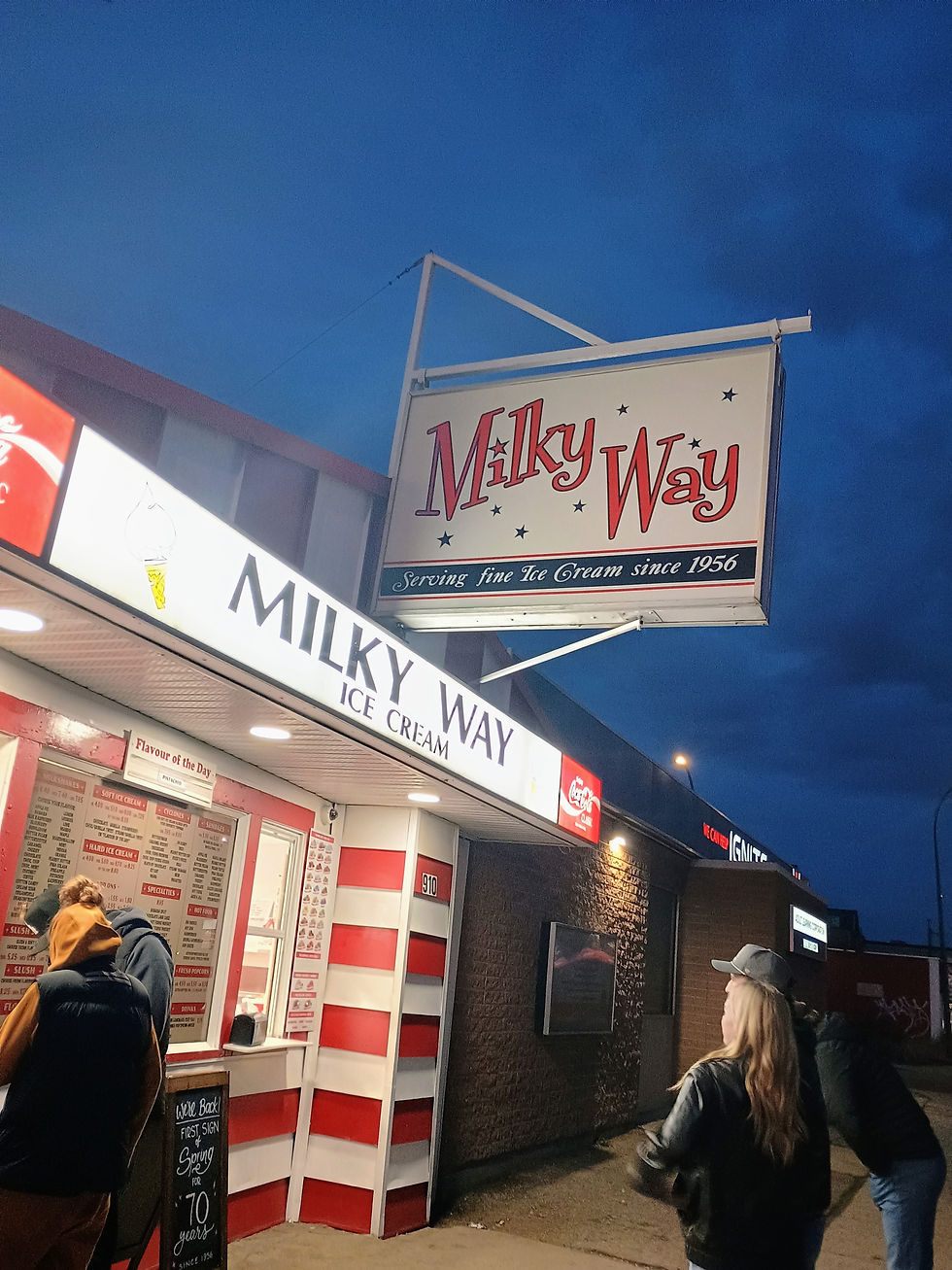
Hopefully the sausage sits well, because it is another early morning tomorrow, to reach unseen frontiers.


Comments